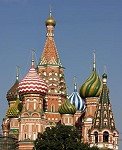
Russian Orthodox Chursh Singers on Kizhi Island (Republic of Karelia, Russia)
Showing posts with label Churches. Show all posts
Showing posts with label Churches. Show all posts
Tuesday, April 14, 2009

Wednesday, September 12, 2007
First Harvard bell returned to Russian monastery after 77 years
A massive Russian church bell that hung for decades at Harvard University was returned to a Moscow monastery Wednesday, nearly 80 years after it and 17 others were rescued from Stalin's religious purges by an American industrialist.
Hundreds of believers flocked to the Danilovsky Monastery, home to the head of the Russian Orthodox Church, for the ceremony to bless the massive bronze bell, officially known as the Everyday Bell. The remaining 17 bells will be shipped to Russia next year.
"The tolling of the Danilovsky bells, which has been stored up for more than two centuries, is again at home at the Danilovsky Monastery and it will call us to prayer from now on," Patriarch Alexey II said in televised comments.
American industrialist Charles R. Crane bought the 18 brass bells from the Soviet government in 1930, saving them from being melted down in purges that saw thousands of monks executed and churches and monasteries destroyed or turned into prisons, orphanages or animal barns.
The original bells were cast in the 18th and 19th centuries and are decorated with etchings of Jesus Christ and Mary, as well as saints and angels. The largest, the Mother Earth Bell, weighs 13 tons and has a 700-pound (315-kilogram) clapper. The smallest weighs 22 pounds (10 kilograms).
They hung for decades in the towers at Lowell House and Harvard Business School's Baker Library.
In exchange for returning the bells, Harvard will receive a set of replica bells cast in Russia and blessed by the Russian patriarch.
Russian oil and metals tycoon Viktor Vekselberg, who has waged a campaign to return cultural treasures such as the Faberge egg collection back to Russia, paid several million dollars (euros) to organize the exchange.
http://www.iht.com
Tuesday, July 3, 2007
RUSSIAN ORTHODOXY WILL BE TAUGHT IN SCHOOL
Elementary schools in a Russian region near Moscow will begin including lessons on Orthodox Christianity starting next year, the governor of the Tver region announced on Monday.
This will make Tver the fourth region in the country to include mandatory instruction on Russian Orthodoxy in its curriculum – a change the governor, Dmitri Zelenin, said most of the region's residents would support, as he said that more than 90% of families in the area considered themselves Orthodox believers.
Students who are not Orthodox Christian, such as the region's Muslim children, will be allowed to study their own religious traditions. Some analysts polled by the newspaper, however, warned that this could have a splintering effect on the local population.
(VREMYA NOVESTEI)
Monday, July 2, 2007
The Russian Orthodox Church
by: John Kunkle
The Soviets did everything they could to squelch religion. They destroyed churches, or turned them into everything from stables to movie theatres. Despite the efforts of the Soviets, the Russian people remained secretly devoted to the Russian Orthodox Church.
They continued to baptize their children and to attend church services. They could no longer do this in public. But they continued in private. When the Soviet system fell, many of the churches were restored and opened for services again.
It is now popular to be a church member again. Many prominent Russians, as well as the common people, are returning to the church.
Russians are steeped in the practices of the Orthodox religion. My wife observes all the intricate rules of the Orthodox Church. When we had our daughter, she would not bring her to church for forty days, as is the Orthodox Custom.
She observes all the customs for honoring those that have died, including burial customs and remembering them in church on anniversary dates.
She will not take communion if she has not fasted beforehand, if she is menstruating, and if she has not recently been to confession. In Russia, she wears a shawl over her head in church, which is the custom of women in her country.
She has not read the Bible and is unfamiliar with the Old Testament. She does not know many of the people in the Old Testament like Moses or David. She knows about Adam and Eve and that’s about it.
She knows the rules well, but she is unlikely to get into deep theological discussions.
Most Russian women will tell you that they are Christian and many wear Crucifixes around their neck.
Russians are devout, but they are not usually regular churchgoers. They go for Christmas and Easter (they call it Pasha) and when the spirit moves them.
Russians are best described as spiritual people, rather than religious people.
As Lynn Visson said in her book, ‘Wedded Strangers’:
“Superstitions are far more important to Russians than religious beliefs.”
About The Author
John Kunkle has been married to a Russian women for over five years. He has travelled the path from finding her, to traveling to Russia, to bring his wife to America, and adjusting to married life. He will show you step by step how to do this yourself. http://www.russian-luv.com/orthodox.html
www.articlecity.com
Saturday, June 16, 2007
Subscribe to:
Posts (Atom)
Blog Directory
 Marketing Blog Directory | Add Blog
List your blog on the Internet's biggest and best Marketing Blog. The Marketing Blog is the premier source for the finding and posting marketing related blogs. Join for FREE!