Russian Orthodox Chursh Singers on Kizhi Island (Republic of Karelia, Russia)
Showing posts with label Culture. Show all posts
Showing posts with label Culture. Show all posts
Tuesday, April 14, 2009

Tuesday, September 16, 2008
Ivan Ivanovich Shishkin

A Rye Field

Morning in a
Pine Forest

Pine Forest, Mast Timber
in the Viatka Province
Ivan Ivanovich Shishkin was a Russian landscape painter closely associated with the Peredvizhniki movement.
Shishkin was born in the town of Elabuga of Vyatka Governorate (today Republic of Tatarstan), and graduated from the Kazan gymnasium. He then studied at the Moscow School of Painting, Sculpture and Architecture for 4 years, then attended the Saint Petersburg Imperial Academy of Arts from 1856 to 1860, graduating with the highest honors and a gold medal. He received the Imperial scholarship for his further studies in Europe. Five years later Shishkin became a member of the Imperial Academy in St. Petersburg and was professor of painting from 1873 to 1898. At the same time, Shishkin headed the landscape painting class at the Higher Art School in St. Petersburg.
For some time, Shishkin lived and worked in Switzerland and Germany on scholarship from the St. Petersburg Imperial Academy of Arts. On his return to Saint Petersburg, he became a member of the Circle of the Itinerants and of the Society of Russian Watercolorists. He also took part in exhibitions at the Academy of Arts, the All Russian Exhibition in Moscow (1882), the Nizhniy Novgorod (1896), and the World Fairs (Paris, 1867 and 1878, and Vienna,1873). Shishkin's painting method was based on analytical studies of nature. He became famous for his forest landscapes, and was also an outstanding draftsman and a printmaker.
Ivan Shishkin owned a dacha in Vyra, south of St. Petersburg. There he painted some of his finest landscapes. His works are notable for poetic depiction of seasons in the woods, wild nature, animals and birds. He died in 1898, in St. Petersburg, Russia, while working on his new painting.
(http://en.wikipedia.org/)
Friday, September 5, 2008
The Charm of Art Nouveau
The elaborate asymmetry and organic, viny images of Art Nouveau are as associated with Paris, Barcelona, Brussels and Riga as colorful onion domes, monochrome block-style apartment buildings and towering Stalinist skyscrapers are associated with Moscow. As the traditional preserve of the Old Russian heritage, the Russian capital hardly seems the place for much modernist European architecture.
But the joy for those just returned from a European vacation, or longing to be, is that the capital has some nice Art Nouveau surprises: tucked away amongst Moscow's characteristic architectural cacophony is a rich bounty of Art Nouveau. Spotting it only requires a stroll through some of the city's quietest streets and a bit of squinting at the skyline.
Moscow's Art Nouveau hot spot is unquestionably the Gorky Museum (Malaya Nikitskaya Ul., 6). Unlike some house-museums of famous Moscow writers, this one has no chance of boring even those who cannot name a single title of Maxim Gorky's works. With a bulging marble staircase that looks perpetually as if it is melting, wood paneling etched with spindly roses, monstrous stained-glass windows, and more, the mansion offers a fair number of surprises, a dreamy confectionery of Art Nouveau's best that Gorky himself, who was settled in the house by Stalin, absolutely despised.
The museum (originally the Ryabushinsky Mansion) was designed by the king of Moscow Art Nouveau, Fyodor Schechtel (1859-1926), whose legacy of not only private houses but also a multitude of functional city buildings largely survives, and some of it, like the Yaroslavl train station, still serves its original function.
The train station, whose tall roof could be from a Russian fairy tale, is reportedly Moscow's busiest. Its traditional Russian motifs mark the station as Neo-Russian, a Russian offspring of Art Nouveau. The distinctive main building of the Tretyakov Gallery, designed by Viktor Vasnetsov, is also considered Neo-Russian.
Art Nouveau is known for its surprising details, and Moscow's version offers a good share. Imaginative human faces, vines, flowers, curves and curlicues can be spotted on facades throughout the area between the Kremlin and the Garden Ring, with key streets being Arbat, Spiridonovka, Ostozhenka and Myasnitskaya.
Another prime example of Moscow Art Nouveau is the Hotel Metropol (Teatralny Proezd, 1/4). The crowning representation of the secular luxury of the rich of the day, the thoroughly Western European hotel is but a short walk from the Kremlin and the staunch nationalism it symbolized. Elaborate mosaic panels designed by artist Mikhail Vrubel cap off the hotel's rhythmic façade and are only barely discernable from street level. A step inside reveals a rich interior that is also replete in fin-de-siècle décor.
Vrubel, with his haunting deep-purple and gray images of mythical women and demons, is perhaps the most distinctive of the many Russian Art-Nouveau artists. The Tretyakov Gallery exhibits a strong selection of his works, whose shimmering colors are truly appreciable only in person.
In its heyday, the Art-Nouveau mood flooded Moscow, with Art-Nouveau porcelain, wallpaper, furniture and stained glass imported and snapped up in mass. Many a Russian advertisement or sign was designed with the style's flamboyant embellishments. The style was largely popularized and propagated by the Mir Iskusstva ("World of Art") magazine, whose chief editor was Sergei Diaghilev, mastermind of the famous Ballets Russes.
Near the end of his career, Schechtel re-designed the Moscow Art Theater (Kamergersky Per.) in a modernist design that was in tune with its founders' desires for non-distracting simplicity. To this day, the theater's seagull insignia and signature typeface are printed in their original Art-Nouveau style.
Sunday, September 30, 2007
Sunday, September 2, 2007
Modest Mussorgsky
By Olga Elmanovich
Russia, Volgograd
Unfortunately, many famous composers are forgotten now. The case is that modern generation don't want to listen to classic music. They find it old-fashioned and useless. But I think that it's just the matter of age. You should grow to the age of understanding such music. Of course it's useless to listen to it, if you don't want to. As for me, listening to classic music is a way of relaxation. While listening, I think about my life, about my mistakes and little victories, about my past and future. I find answers in this music. Modest Mussorgsky is the kind of composer, that I really like.
Modest was born on the 9th of March in 1839 in the village near Pskov city. His father was a nobleman. He remembered about the place of his childhood as about that place, where first musical improvisation came to his head. At that time he couldn't play the piano at all, he was about five. His mother started to learn Modest to play the to play the piano, when the boy was six. Everybody understood, that Modest was very talented.
And a year later he could play some piano works of List (a composer). Modest's talent pleased not only his mother, but his father too. But no one in the family could even imagine, that Mussorgsky would become a professional musician. So Modest and his brother in 1852 entered the school of ensigns in St.-Petersburg. He still liked music and studied it with help of his teacher � a famous pianist, named Gerk. At that period Mussorgsky wrote his first work "An ensign".
In 1856 Modest met Dargomyjsky ( a very popular composer of that time). So he started to communicate with him and some other composers. It was very important for Mussorgsky to find people, who would share his interests. Very soon Mussorgsky understood, that music is not only a kind of joy for him. He wanted to become a real professional, so he left his active service and devote his life to music.
It's not a secret, that till 1861 year his life was not very difficult. Modest had enough money, but then serfdom was canceled. This situation influenced on many noblemen. The majority of them were ranted. Modest hardly could tie up the loose ends. But he kept on working. In 1869 the composer finished the first version of his opera "Boris Godunov" (Russian king). He worked on it a lot, and it really pleased him, he lived for each note of this opera. But the director of Mariinsky theatre refused to show it to the public. Now, people believe, that he did it, because was a bit afraid of music, which was very modern for that times. So Mussorgsky made a new version of it and in the 1874 people heard it. The huge success came to this opera many years later, after Modest's death in 1908, when it was produced in Paris and submitted Europe first, and then the whole world. "Boris Godunov" was his most successful work. Till our days we enjoy it in Russian Russia and European theatres.
Last years of Mussorgsky's life were very difficult. He had no money, he wasn't needed, so he started to drink. His friends tried to help him, but in vane. He didn't want to live any more. He died in 1881 in military hospital in Nikolaevsk. No one cared about his death, accept his close friends. No one cared, that he was a genius, while he was alive. Long after it, people understood, that Modest was a great person, that his works are true masterpieces.
Unfortunately, such stories, happened very often with great people. They often are estimated after death. But I really think, that older generation will always appreciate Mussorgsky!
(TENAN CONDUCTS MUSSORGSKY TABLEAUX D'UNE EXPOSITION)
Friday, August 31, 2007
10th Moscow Book Fair to Celebrate the Year of Russian Language
The 10th Moscow International Book Exhibition-Fair will be held on the territory of the All-Russian Exhibition Centre (VVTs) from 5 to 10 September.
The exhibition dedicated to the Year of the Russian Language will gather together around two and a half thousand participating organizations. Book publishers and traders from about 50 to 60 countries are expected to take part in the fair, China being the honoured guest this year. The exposition of the Chinese Republic promises to be grandiose, taking the area of over a thousand square meters.
Russian and foreign authors, including writers, poets, scholars, journalists, artists and politicians, will be among the guests of the fair week.
Over 150 thousand people are expected to visit the 10th Moscow International Book Fair.
Source: rian.ru
Monday, August 27, 2007
Museum of Russian Emigration to Open in Stavropol Territory
The Museum of Russian Emigration will be open in Kislovodsk town on the initiative of the well-known patron of art, Baron Eduard von Falz-Fein from Liechtenstein. He has already been awarded the Pushkin Medal for his contribution into preservation of the cultural heritage of Russia. According to him, the choice of Kislovodsk town as the place for the future museum was not accidental: this Russian town was one of the centres of the so-called “Caucasus emigration”. The patron of art presented the museum with the sculpture of Fyodor Shalyapin created by the famous sculptor Dmitry Tugarinov. It was in Kislovodsk were the last Russian concert of the great bass singer took place before he emigrated. Falz-Fein is known as the patron of art who has searched for treasures of the Russian Emperors’ family. Throughout all his life the baron purchased many works of art at auctions, including Sotheby’s and Christie and then handed them over to Russia.
Sunday, August 26, 2007
Russian Dance
Kalinka Dance. This is a best example of character dance perfomed by best dances in the world.
Ensemble Barynya is performing a traditional Russian Cossack dance routine consisting acrobatic tumbles, jumps, spins and leaps and the ... all » infamous cossack kicks! Brooklyn based Russian Cossack dancers reproduce the ethnic Cossack dances of the region in stage adapted form
Russian beauties performing Russian Dance.
THE VOLOGDA LACES

By Lyubov Tsarevskaya
The Museum of Lacework in Vologda can well be called a museum of beauty. On display are all sorts of the centuries-old handicraft – table napkins, tablecloths, cloaks, capes and collars, which continue to gladden the eye and fill people’s lives with comforting grace.
The art of lacework originated in Europe in the 15th century. In Russia the fine fabric of woven patterns appeared in the 17th century and was brought from abroad. Lacy items of clothing went into fashion in Russia in the 18th century stimulating the appearance of domestic lace makers. The Vologda Region, known for its flax growing industry, became one of the lace-making centers. The first lace-making workshop in Vologda appeared in 1820 and belonged to a local landlady, Zasetskaya. Having a passion for all kinds of needlework, Zasetskaya sent her 10-year-old serf girl, Anna to do a lace-making course in the Yaroslavl province. After she completed the course five years later Anna passed on the art of lace-making to the local girls and young ladies. Work in the lace-making workshop was hard indeed – the women had to toil 16 to 19 hours in poorly lit rooms, so their vision lost acuity by the time they turned 40 or 45. The particularly good ones were forbidden to marry and have families, because their work was believed to be much more important and they weren’t to be pulled away from it. So how did they make the laces?
On a wooden stand they put a bolster filled with straw or sawdust and dressed it in a white pillowcase. The lace was woven on a pattern pinned to a piece of cardboard and the lace-maker saw as she sat down to weave what pattern she was doing and where to place a pin. The laces were made with the help of spindles — a pair of wooden sticks that had a flaxen thread fastened to them. The main lace-making material was flax, which is found in profusion in Vologda. Flax was always highly honoured in Russia and linen clothes were considered sacred for it was widely believed that the first priests and Jesus Christ wore linen. In the pre-Christian period flax was as valuable as gold.

Originally laces in Russia were narrow strips up to 10 meters long and were used for trimming skirts, sleeves and collars. The trimming was mostly circular then. The 19th century introduced more variations, so there appeared large pieces of lacework done bit by bit and connected into a whole panel with the help of a metal hook. The resulting produce included tablecloths, large napkins, capes, bed covers and cloaks. The more complicated the pattern, the greater number of weaving spindles was needed. The more experienced lace-makers used up to 800 pairs of weaving sticks, which is really hard to believe nowadays!
In late 19th – early 20th century the Vologda Region boasted about 40 thousand women lace-makers, so every other Vologda woman made laces either professionally or for her own use. The most popular of the tradeswomen was Anfea Briantseva. She taught her daughter, Sofia, to handle the spindles when she was 5 years old, so by the age of 10 the girl was teaching the trade to her peers. All in all, Sofia prepared about 800 lace-makers keeping the good tradition and handing it down from generation to generation.
Every lace-maker invented a pattern, in most cases a floral ornament. Sometimes, however, you can see a bird with a woman’s head. The bird is believed to tell one’s fortune and by depicting it the lace-maker wanted to appease her in the hope of getting her patronage in life.
The Vologda lace-making trade reached its prime in the years after the Second World War. The demand for the laces was high, with nearly every Soviet woman determined to make them the necessary decorative item of her household. In 1964 a lace-making factory was set up in Vologda which was named “Snezhinka” (or “Snowflake”) after the tablecloth created by Victoria Elfina, the factory’s chief artist. The tablecloth took months of backbreaking work. For four months Victoria laid the pattern on cardboard, then 25 women wove the cloth on fragments for two months, and another three months went to connect the fragments into one whole with a special hook. The result of a nine-month effort was a monumental piece of work which stays unparalleled to this day.
The Vologda factory continues to keep the brand high and the Vologda laces stay popular in Russia and abroad. Russian celebrities often place orders for stage outfits with the Vologda lace-makers and never go disappointed since the laces, done Russian-style, look graceful and out of this world. http://www.ruvr.ru
Sunday, August 12, 2007
Russia’s Kaliningrad region re-lives Viking era

The Viking Era International Festival has brough history back to Russia's Kaliningrad region. The Vikings entered the resort city of Zelenogradsk singing and dancing to the sound of rattles and drums.
The beach filled with costumes and characters from the Middle Ages, Peasants with their long sleeved wool shirts and the Viking elite with their bright capes and traditional weapons. Aleksandr Pritalkov plays the role of a sea warrior. The main element of his costume that was tailored for many months in a history club is the armour. It’s quilted instead of traditional heavy steel.“They didn’t use heavy armour during the Viking period like they did in the knights era. All the main battles were held at sea. If we fall into the water wearing chain armour there’s no chance of survival - with this there is,” Aleksandr explains.The Viking Era International Festival of historic reconstruction was founded after archeologists discovered a burial site of Lithuanian warriors who fought against the Order of Teutonic Knights in the 14th century. Even the skeptics were convinced that Vikings inhabited this area after women’s jewelry of Scandinavian origin was found.Large-scale research of the area uncovered surprising discoveries that further undermine the perception that Vikings were little more than merciless sea thugs.Historians tell us the Scandinavians often settled on new territories as traders and craftsmen.The festival showcased Viking martial arts, crafts and their way of life. Visitors could learn how to weave a canvas, make paper and ceramics, create jewelry, toys and weapons. Visitors were given the opportunity to become a Viking for a day by putting on ancient jewelry and armour and shooting with a real bow and arrow.http://www.russiatoday.ru/
The beach filled with costumes and characters from the Middle Ages, Peasants with their long sleeved wool shirts and the Viking elite with their bright capes and traditional weapons. Aleksandr Pritalkov plays the role of a sea warrior. The main element of his costume that was tailored for many months in a history club is the armour. It’s quilted instead of traditional heavy steel.“They didn’t use heavy armour during the Viking period like they did in the knights era. All the main battles were held at sea. If we fall into the water wearing chain armour there’s no chance of survival - with this there is,” Aleksandr explains.The Viking Era International Festival of historic reconstruction was founded after archeologists discovered a burial site of Lithuanian warriors who fought against the Order of Teutonic Knights in the 14th century. Even the skeptics were convinced that Vikings inhabited this area after women’s jewelry of Scandinavian origin was found.Large-scale research of the area uncovered surprising discoveries that further undermine the perception that Vikings were little more than merciless sea thugs.Historians tell us the Scandinavians often settled on new territories as traders and craftsmen.The festival showcased Viking martial arts, crafts and their way of life. Visitors could learn how to weave a canvas, make paper and ceramics, create jewelry, toys and weapons. Visitors were given the opportunity to become a Viking for a day by putting on ancient jewelry and armour and shooting with a real bow and arrow.http://www.russiatoday.ru/
Tuesday, July 31, 2007
Russia's Bolshoi returned to old glory by 2008
Moscow's Bolshoi Theatre has been saved from virtual disintegration by massive renovation works and is now racing against time to reopen in autumn 2008, the theatre's head said on Tuesday.
In July 2005 the Bolshoi, one of the world's leading opera and ballet companies, closed for restoration, its facade tarnished and walls and columns pitted by decades of neglect.
Behind the facade, however, things were much worse.
"More than 60 percent of the building was in a dilapidated state, its bricks virtually crumbled in your hands," Bolshoi Director General Anatoly Iksanov told a news conference.
"Restoration and reconstruction continues round-the-clock. The problems the workers face are truly colossal," he said.
"We very much hope we will enter a renovated building in autumn 2008 ... But so far it's all in God's hands."
Founded by a decree of Empress Catherine the Great in 1776, the Bolshoi acquired its current building in 1825 after fire gutted the original home, the Petrovka Theatre, in 1805.
In 1853 the Bolshoi was again badly damaged by fire, but within three years it reopened.
This time, the state allotted 15 billion roubles ($585 million) to renovate the Bolshoi. Its eight-columned portico crowned with the Greek God Apollo riding a four-horse chariot appears on chocolate wrappers and 100-rouble banknotes.
Workers have stabilized the Bolshoi's foundations with hundreds of piles and reinforced its walls and columns with steel bars. Modern stage technology will be installed and backstage areas will be repaired as well.
The Soviet Union's huge hammer-and-sickle coat of arms on the facade has been replaced by the original two-headed eagle of imperial Russia.
Russian tsars and Soviet leaders alike loved to visit the Bolshoi and invited important foreign guests to the theatre.
In 1944 Soviet leader Josef Stalin took British Prime Minister Winston Churchill to the Bolshoi where he was accorded a standing ovation. In 2002 an unexploded World War Two bomb was found under one of the Bolshoi's entrances.
Famous ballerinas such as Galina Ulanova and Maya Plisetskaya and bass opera singer Fyodor Shalyapin and tenors Ivan Kozlovsky and Sergei Lemeshev all performed at the Bolshoi.
"We are carrying out a lot of work to recover the original quality of sound," Iksanov said.
"But we do not try to invent something new, we simply want to regain what existed back in 1856." Dmitry Solovyov, Reuters
Friday, July 27, 2007
Russian Literature
Russian books you can read in English online:
Alexander Pushkin's verse in English translation
Fyodor Dostoevsky. The Brothers Karamazov
Fyodor Dostoevsky. Crime And Punishment
Anton Chekhov. Selected works
Leo Tolstoy. Selected works
Ivan Turgenev. Selected works
Mikhail Bulgakov. The Master and Margarita
Alexander Pushkin's verse in English translation
Fyodor Dostoevsky. The Brothers Karamazov
Fyodor Dostoevsky. Crime And Punishment
Anton Chekhov. Selected works
Leo Tolstoy. Selected works
Ivan Turgenev. Selected works
Mikhail Bulgakov. The Master and Margarita
Thursday, July 12, 2007
Russian villages of Fedoskino, Palekh, Kholui and Mstera
 Russian lacquer boxes are among the most beautiful and distinctive of that country's art achievements in the 20th century. The boxes, which vary in size, are extremely well crafted. It can take as long as two months to make a box out of papier-mache, a material many artists prefer because of its ability to withstand changes in atmospheric conditions and to avoid cracking. The lacquer box sitting on your mantel today will likely be enjoyed by many generations.
But it's the miniature paintings that bring real value to the boxes. Lacquer artists must not only excel artistically, but must also have the patience to spend long stretches of time working on the many small intricate sections of their composition. Artists will typically use strong magnifying glasses on these spots and very fine brushes made out of a squirrel's tail.
The boxes most widely sought after come from one of four small Russian villages - Palekh, Fedoskino, Kholui, and Mstera. Each village also has its unique style. Boxes from Palekh might well enjoy the highest world-wide acclaim. The lacquer art of Palekh has been called "a small miracle", a label particularly fitting since that the village specialized in icon-painting for centuries until the 1917 Russian revolution. To many collectors, Palekh boxes have the most elegant look to them.

Boxes from Mstera, though, usually have the lightest colors. Artists there almost never choose black for their backgrounds, and instead use light blue, pink, gold or ivory colors. With the addition of these colors, landscapes generally play a more prominent role in Mstera works, and people and objects tend to take a place within the background setting rather than remain separate from it. In Mstera, a wide range of artistic talent exists. While some artists paint dynamic and elaborate scenes from fairy tales or famous battles, others concentrate on exquisite floral designs.
Monday, July 9, 2007
The Hermitage’s existence is one of the few signs that Russia belongs to Europe
Interview with Director of the Hermitage Mikhail Piotrovsky
When the matter concerns scientific institutions, one recalls first of all academic and branch institutions and higher education institutes (although lately there have been restrictions in the line of a proper scientific work), however science also lives in archives, libraries, museums, as well as, in informal scientists’ communities. The registration of the world experience would add private corporations to that list. “The advanced science” opens the cycle of materials about existence of science in such places and forms, about which the government prefers to forget starting from the tasks of “regular” administration, and citizens may not know at all.
It was fortunate that the publication of our first conversation from this cycle contemporized with International Museum’s Day, because our interviewee is Professor Mikhail Piotrovsky, Director of the State Hermitage, Doctor of historical sciences. Mikhail Borisovich Piotrovsky is a corresponding member of the Russian Academy of Sciences, full member of the Russian Academy of Art, deputy chairman of the President’s Council for Art and Culture. He is also chairman of the Union of Museums in Russia, professor of St. Petersburg State University, chairman of the tutorial board of the European University in St. Petersburg, president of Worldwide Club of St. Petersburgers. His scientific interests are: Arab and Islam culture and art, archeology of the Middle East and Yemen, ancient Arabic epigraphy, history of the World and Russian museum management studies and art collections. Interviewed by Natalia Demina.
Coming to our meeting, I saw how brides and bridegrooms took pictures in a sunny day at the Hermitage’s doors and put bouquets at the Atlantes’ feet…
That is such a Russian and St. Petersburg tradition when newly wedded on the day of their wedding drive around the memorable places. It’s very interesting to watch what historical monuments they visit. Today many young people get married in church, but all the same they come to “Bronze Horseman” – Peter the Great monument on Decembers’ square, The Church of Our Saviour on Blood, Point of Basil’s Isle, to those place which are pride of Russia, the part of our historic memory and this is very important. The Hermitage is an integral part of St. Petersburg’s atmosphere, that’s why young people come to the Hermitage’s atlantes. May be they don’t know who atlantes are and visit seldom the museum, but I saw more than once how the newly wedded come to the Hermitage the day of their wedding.
The newly married couples walk about the Hermitage, take pictures. It gives them pleasure as it’s one of the functions of the museum. Such a tradition is a part of the interaction of the Hermitage with society.
Quite often one can hear such point of view that science can be only in higher establishments and academic institutions? Is there science in museums in your opinion?
First of all there is science in museums and it must be so. It is occasionally said, that museum’s director must not necessarily be a scientist, that museums are not scientific institutions, but either an entertainment center or a place of rendering of services. In my opinion, the idea, that science must be only in scientific-educational establishments is not only wrong, but very harmful aimed at removing science from Russia. And the question is not about science reform. “Reform” in our country is such a fashionable word, as it was before “the bright future”. The matter is that such transformations will result in that museums will suffer or even that they will completely perish as serious culture establishments.
The issue that you’ve touched is very serious and completely true. This is a very fundamental and important question, which is at the front of the struggle for preservation of our culture. Culture in the past years has been the only convertible product. Certainly, besides oil and gas resources and arms.
Recently all Russian museums have passed through very strange procedure of changing their charters, as the result the clause scientific activity has been removed from the charters. We had to “struggle with teeth” asserting our right for scientific activity, and we have managed to retain this line of activity.
More...
Thursday, June 14, 2007
Get A Taste Of The Hot and Rapidly Aspiring Alexander Lunev’s Guitar & Keyboard Music - Finger Dancing At It’s Best!

by: Lucy Boutaleb
This article is all about the incredible artist Alexander Lunev, who is about to take the International music scene by storm!
Musical Contribution Awards!
Alexander Lunev appeared at MTV's 13th annual European Music Awards contest to receive "Best Russian Act" nomination for RMA (Regional Music Awards), held in Copenhagen on November 2nd 2006 for his musical contribution with the dark pop song: "Never Let You Go" and sung by Dima Bilan. The show featured some of the biggest names in the music world including, Red Hot Chili Peppers, Keane, Snoop Dogg and Justin Timberlake who won best male and best pop award.
Virtuosity!
Russian musician and producer Alexander Lunev is arguably Russia’s leading contemporary composer. However, what makes him special is that he has a unique way of expressing his prodigious musical talents. Every melody is a sublime and exhilarating listening experience; that’s how enthralling and refreshing his sound is!
Unsigned Talent!
Incredibly though, Alexander Lunev is unsigned to any record label in the rest of Europe and America as yet, however, he is rapidly catching the attention of many important players in the music industry. Alex’s instrumental ambient type music is perhaps more akin to that of the famous Vangelis, whilst his methodically sequenced and lush electronic progressive genre is probably closer to that of Ryuichi Sakamoto.
Influential!
Alexander Lunev has collaborated with a number of singers effortlessly influencing all with his creative and unique sounds. Witness the energy and artistry of his compositions. This is definitely a music that can lift one to the highest state of melodic level. His compositions journey through a myriad of genres gently bathed in intricate, yet futuristic harmonies.
Inspiring!
Collaborating with the award-winning Dima Bilan, that magical talent was finally revealed captivating a huge global audience! Everybody will recognise the song "Never Let You Go" brilliantly composed by Alexander and superbly sung by Dima at the Eurovision 2006 that made it to number two before it shot up the single’s chart and became an instant smash hit in many countries. In February 2007 Dima Bilan will record two of Alexander’s compositions in Los Angeles with the producer of "Black Eyed Peas" who is very interested in Alexander’s music and he has plans to duet with the pop diva Shakira in the very near future.
Aspiring!
What separates and truly distinguishes Alexander from many other musical artists and composers are the absolute brilliant command he has over the guitar and keyboard! For those who have not yet heard the soundtrack from the movie "Ballet of the Butterflies" you may want to check that one out first on Lunev’s website http://www.lunev.info. However, for those who are already fans of the artistic brilliance that Lunev creates through his music like; "Through The Eyes Of The Eagle", "Following the Trail", "Above the Ocean", "Drowning Man", "Return to the Heavens", "Never Let You Go" (B. Bilan) and "Lady Flame" (B. Bilan), are definite must-have.
Creativity!
Complementing and pushing his sound creativity vision further, Alex, who is also musical producer for the group "Koroleva" ("Queen"), are together recording his latest composition titled "Snow" due to be released this Christmas. Alexander has contributed to two popular movie soundtracks, notably one for the Russian movie “Frenchman”. In addition, he wrote and produced the rock-opera "Prodigal Son" based on classical evangelic texts, further testimony of his boundless genius.
Dexterity!
The undeniably guitar virtuoso and talented keyboard player who can take any style of music and give it a special twist to suit, has excelled in a wide range of music styles rightly carving a name for himself in popular, orchestral and film music. His fan base age ranges from 13-25 year olds for his songs, while not surprisingly perhaps his sensational "electronica" collection captivates the over 21’s.
This year marked a truly significant step forward in the realm of electronic music delivering an astonishing musical repertoire like no other. Alexander new material is already popular in his adopted home city Moscow and boasts a loyal following ranging between 25 to over 80 year olds, further testimony of his fans wide age group musical taste appeal.
Forward!
Adding new material, Alexander reappeared this fall to pursue his interest in "world music" with an instrumental album titled "Through the Eyes of the Eagle" that strikes the head and grabs one’s soul. This album is scheduled for release in the very near future, but no firm date as yet.
Needless to say this pioneering composer and enormously talented artist is definitely poised for global stardom!
For more information or to get in touch with Alexander Lunev please contact Yan Valle or visit Alexander Lunev’s official website: http://www.lunev.info/ Contact Info: Manager: Yan Valle Phone: (+1 416) 877 5817 Email: info@lunev.info URL: http://www.lunev.info/
Friday, June 8, 2007
Moscow Film Festival to feature 20 competitors in late June
Moscow will host an annual international film festival June 21-30, with about 20 pictures featuring in the competition program, the chairman of the festival selection committee said Friday.
Andrei Plakhov said the program would feature three Russian films - Larisa Sadilova's Nothing Personal, Vera Storzheva's Traveling with Pets, and Valery Ogorodnikov's Putina.
Three non-Hollywood American films have also been announced in the competition program, Plakhov said.
"It is a low-budget but very interesting film," he said presenting the film Viva, a debut by Anna Biller as both director and scriptwriter. The other two U.S. films are Broken English by Zoe Cassavetes, the daughter of renowned director John Cassavetes, and Noise by Henry Bean.
Other films in the competition program are:
- Ledsaget Udgang by Erik Clausen (Denmark)
- The Children of U.S.S.R. by Felix Gerchikov (Israel)
- International by Sirri Sureyya Onder and Muharrem Gulmez (Turkey)
- Mein Fuhrer by Dani Levi (Germany)
- Moliere by Laurent Tirard (France)
- Man's job by Aleksi Salmenpera (Finland)
- Opium by Janos Szasz (Hungary)
- By Riverside by Eva Neiman (Ukraine)
- Murder of the Inugami Clan by Kon Ichikawa (Japan)
- Eduart by Angelika Antoniou (Greece)
- Russian Triangle by Aleko Tsabadze (Georgia)
The festival will also run the film La Sconosciuta by Giuseppe Tornatore, starring Russian actress Ksenia Rappoport as a "Ukrainian girl, Irina, who finds herself in a critical situation in Italy and has to struggle for survival," Plakhov said.
The final list of competing films will be available after June 9.
The Moscow international film festival has been held since 1959. In 1972, it was registered with the International Federation of Film Producers Associations as a major and prestigious festival with the same status as the festivals of Berlin, Cannes, San Sebastian, Karlovy Vary and Venice. The Moscow festival has been held annually since 2000. (http://en.rian.ru)
Saturday, May 26, 2007
Video Tours
These are the videos of some St-Petersburg's sightseeing tours, you might find them interesting:
http://youtube.com/watch?v=qOJNOuCuUzI
http://www.youtube.com/watch?v=ijiEcsA291I
http://www.youtube.com/watch?v=aJK8GPnlPa8
Famous Hermitage Video Tour:
http://www.youtube.com/watch?v=cHSswzB1P_U
http://youtube.com/watch?v=qOJNOuCuUzI
http://www.youtube.com/watch?v=ijiEcsA291I
http://www.youtube.com/watch?v=aJK8GPnlPa8
Famous Hermitage Video Tour:
http://www.youtube.com/watch?v=cHSswzB1P_U
Tuesday, May 15, 2007
Ekaterinburg Museum of Fine Arts

The museam is famous for the unique collection of Kasli cast-iron moulding and especially, with Kasli cast iron Pavilion.
But besides the pavilion the museum has got quite a number of real masterpieces of Russian, West Europe, applied and modern Arts.
The department of Russian Painting’s got a big and constantly replenishing collection of icons, referring to 16-19th centuries.
It is 700 items. Russian Art of the 2nd part of 18th - 1st quarter of 19th is introduced by the works of F. Rokotov, D. Levitzkiy, V. Borovikovskiy, V. Tropinin, K. Brullov, A. Venitsianov, I. Aivazovskiy.
The Art of the 2nd part of 18th century is represented by so called artists-peredvizhniks V. Perov, I. Kramskoy, G. Myasoyedov.
The end of 19th c. was the top of Russian painting and the  time of creation of different art associations.
 The museum has several pictures of the Association “The World of Art” created by A. Benua, S. Sudeykin . Significant part of the collection of West Europe Art contents the pictures of Italian artists of 14-19th cc.
Besides the drawings from France , Holland, Germany. The collection of Russian Avant-garde of 1910-1920 is the  property of the museum. At the exposition on Vayner st. The pictures of K. Malevitch, V. Kandinskiy, M. Larionov, N. Goncharova, I. Mashkov Are represented as well.
 Saturday, May 5, 2007
Sightseeing in Moscow

Red Square Secrets
Red Square is the famous square in Moscow which used to house huge military parades during the Soviet era.The word "red" doesn't refer to the color of the bricks or to Communism. In Russian, the square is called Krasnaya Ploschad. The word krasnaya means both "red" and "beautiful," and the latter, referring to St. Basil's Cathedral, was the original meaning. The Red Square has several notable places within or framing the space. One of these is Lobnoe mesto.Lobnoye Mesto
Lobnoye Mesto, or "Place of Skulls," is a circular raised platform on which public executions were carried out in the days of the tsars. In 1768 next to Lobnoye Mesto the landowner Darya Saltykova, who had tortured 139 of her serfs to death, was exposed to public contempt in the pillory. While a scribe read out the list of her crimes, Saltykova stood with her head bared as an act of humiliation, and a label was hung round her neck with the legend: 'Torturer and Murderess.' After this she was sent to Ivanovsky Convent and confined there for the rest of her days.
Memorial to Minin and Pozharsky.
They were the leaders of the second group of Russian irregular soldiers in 1612, and the memorial was erected in 1818 to the design of the sculptor I. Martos. One of the bas-reliefs depicts how the citizens of Nizhny Novgorod on the Volga responded to Minin's summons by leading their sons to be armed, while the other shows the flight of the Poles from the Kremlin, and the Russian troops chasing after them. Up to 1936 the memorial stood in the centre of Red Square, with Minin symbolically indicating to Pozharsky that the Poles were occupying the Kremlin and calling for its relief.
However, Lenin's Mausoleum was built right opposite the memorial, and Minin's summons to battle was felt to be ambiguous, and the memorial was also a nuisance during parades. An instruction was given for its destruction, but later it was transferred to a position close to St. Basil's Cathedral.
Mausoleum
The Mausoleum was built in January 1924 to preserve Lenin's body. The name comes from the grand tomb of King Mausolus of Caria, which was built in Halicarnassus in the fourth century BC. Lenin's coffin was brought from the village of Gorki, where he died, on 23 January and placed in the Hall of Columns of the House of Unions for people to pay their last respects. The same night the architect A.Shchusev was instructed by the government to design and build a temporary mausoleum near the Kremlin walls in which the body would remain until the funeral. Shchusev wandered around Red Square for a long time, and by sunset the design for a wooden mausoleum was prepared. It was in the form of a cube (the symbol of eternity) with a height of three metres. Lenin's body, with its face uncovered, was placed in a glass sarcophagus, and thousands of people filed past each day.
Krupskaya, Lenin's widow, and his brother and sister protested at this blasphemous form of burial, and expressed the wish that he be laid to rest in the earth. However, Lenin's closest political allies were intent on exploiting his body for Bolshevik propaganda and to strengthen their grip on power.
Saint Basil's Cathedral
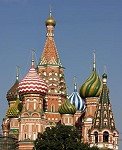
At the southern end of the square is the elaborate gold-domed building of Saint Basil's Cathedral and also the palaces and cathedrals of the Kremlin. Real official name of this building is "the Cathederal of the Protection of Our Lady on a Dike", but it is better known as "Vasiliy the God's Fool" (or St. Basils in English). It was built in times of Ivan the Terrible in honour of victory of Moscow over Kazan. The building appeared to be so beautiful, that tsar Ivan ordered to blind an architect. Justly he was called Terrible. In 1812, the French army stabled their horses in St.Basil's Cathedral. Before leaving Moscow, Napoleon ordered it to be blown up,but cold, hunger and fear of sabotage by the people of Moscow prevented the order from being carried out.
(http://www.ruscuisine.com)
Subscribe to:
Posts (Atom)
Blog Directory
 Marketing Blog Directory | Add Blog
List your blog on the Internet's biggest and best Marketing Blog. The Marketing Blog is the premier source for the finding and posting marketing related blogs. Join for FREE!